Showing posts with label Hokkaido. Show all posts

Friday, 8 January 2016

3) AOMORI CITY 青森市 – Rassera, Rassera: The Story of the North

A voyage to Aomori, Part 3 of 5


From the sanctuary of Osorezan I crossed back to this world of artifice and illusions. A two-hour descent from the Shimokita Peninsula by train brought me to Aomori City (青森市), the capital of Aomori Prefecture and my base for a few more days of northern exploration.

Aomori. It is a name synonymous in the Japanese imagination with scallop-fishing, apple-growing, and above all the Nebuta Festival.


The city perches at the south end of Mutsu Bay, at almost the geographic centre of the prefecture, where it brings together the diverse cultures, histories, trades and forces of nature of a land whose present form is of very recent construction. Most of Aomori City as we know it today was built upon the wreckage of World War II, while the concept of Aomori Prefecture as a coherent unit is scarcely a century old. Let's take a look at the story of the north end of Japan.


The First Peoples and the Japanese Conquest 
If we speak of illusions, we should do away with one of this country's most popular: that is, the myth of the homogenous nation. The closer you actually look at Japan, the less escape there is from the hollowness of those claims that this is a land of one people, one ethnicity and one culture.

Get on a bus at Aomori Station and within twenty minutes you come to one of Japan's most interesting archaeological excavations, right there in the suburbs of Aomori City. The oldest finds at the Sannai-Maruyama site (English website here) date back almost 6,000 years, to the world of the earliest known inhabitants of this region.

Saturday, 10 October 2015

1) THE SHIMOKITA PENINSULA 下北半島 – A Bridge Between Worlds

A Voyage to Aomori, Part 1 of 5


It beckoned. Cold, remote and foreboding at the edge of Japan, an axe-shaped wildnerness unknown in the English-speaking world and far from everything.

The Shimokita Peninsula (下北半島) marks the northernmost frontier of Japan proper. It was one of the final territories to be reached and incorporated into the Japanese nation (apart from Hokkaido in the north and the Ryukyu Islands in the south, which are in essence different countries, though that is another story.) 

Long had I felt the call to explore these reaches. However, four years into my residence in Japan an impossible set of circumstances emerged in the face of which a retreat was the only option. Shimokita become the inevitable destination.

North, just as before – as on that voyage to that other world, Hokkaido, and those explorations of Tohoku around that time or since. But this time was different. This was a necessary flight to the fringes of this land, in search of a crossing to a very different kind of realm. 

Osorezan (恐山). The so-called mountains of fear, a mysterious beacon at the centre of Shimokita. Its name is well-known throughout Japan, for Buddhist mythology has it that it is the entrance to hell, and a place through which everyone must transit after they die. Its landscape is volcanic, sulphurous, bizarre, and charged with a strange spiritual energy: a place of dread to some, of peace to others, for it seems all react to it differently. This was the place I sought, though I cannot entirely say why. 

On the way I found there is more to Shimokita than its image suggests. Like most places considered remote, peripheral and empty, it seems Shimokita has long been exactly the opposite. For it guards the Tsugaru Strait (津軽海峡), a crossroads of history which has brought together people, information, cultures and goods from different lands over hundreds of years. Cold it certainly is, and out of the way to most of us it may be, but Shimokita reaches out for the worlds of the northern seas, on top of connecting those of the living and the dead, and has a beauty of its own that is one of a kind yet varied, subtle yet full of character.

Aomori Prefecture, in red, courtesy of Wikimedia Commons. Shimokita is its eastern peninsula. Together with the Tsugaru Peninsula (the western one) it encloses Mutsu Bay. To their north the deep Tsugaru Strait separates Japan's main island of Honshu from Hokkaido.

Shimokita.

It is here that we shall open this five-article series. It covers a journey that would continue on to Aomori city (bottom-left on the map above), and from there into the mountains and forests that stretch down this prefecture's centre. But let us start where that journey began: on a train that rocketed out of Tokyo one bleak end-of-summer morning. By the afternoon it had reached Aomori Prefecture, where I changed at Hachinohe then Noheji onto ever smaller trains, which finally trundled, as evening fell, up the windswept axe-handle of the Shimokita Peninsula.

Wednesday, 19 September 2012

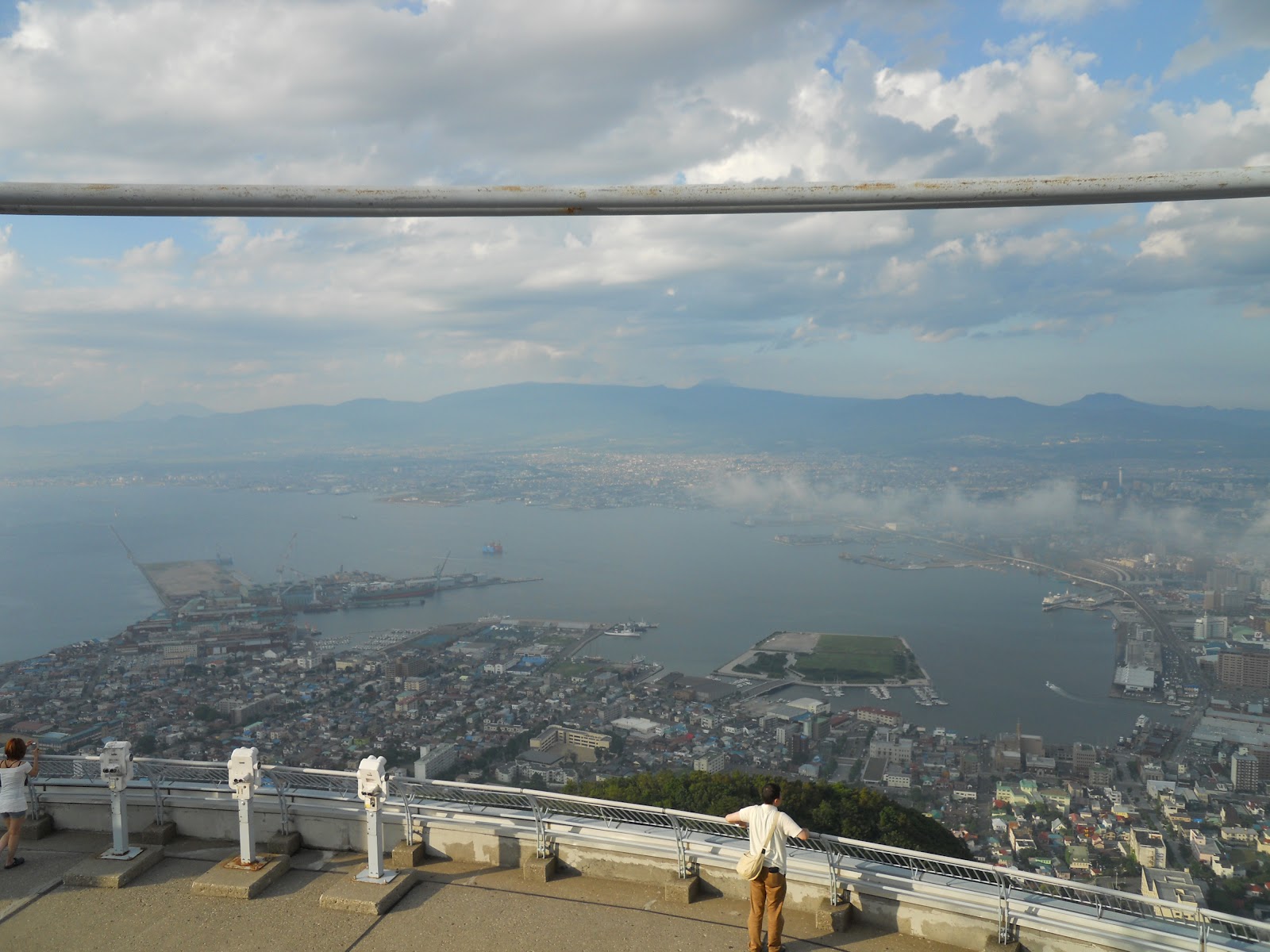
7) HAKODATE – Beginnings and Ends (函館)


It is the end of winter, 1854, and you gaze across the glistening waters of Hakodate harbour. As far as you're concerned, this is the greatest and safest port in the world. But the light of the sun and cool, crisp winds of the sea do little to comfort you.

You are on edge, and so is everyone else still here. The authorities have herded the townsfolk far away, along with their horses, their ships – is it because those who are coming are frightening? Or is it that what they are bringing, and you sense this too, might just herald the cataclysmic collapse of your world, the only world your civilization has known for centuries?


What goes through your mind, your heart, as the Black Ships (kurofune, 黒舟) loom into the bay? They intrude with the certainty of drifting death. You know who is on them. And when the shogunate brought humiliation on the imperial throne by giving in to the foreigners' demands to open up, it is here – in Hakodate – that this capitulation actually means something. That's why the Black Ships are here: surveying the port they've coerced open to service the desires of foreigners and their ships on whatever terms they wish; the port which within five years, after centuries of seclusion, is to be forcibly plugged into the wild and whimsical network of international trade.

Within a few short years they'll come and go as they please, bringing all their crazy ideas and technologies with them, for good or for ill. And after a few years more, the Japan of the Tokugawa shoguns will collapse on itself: and right here, in Hakodate, is where its violent death throes will at last subside, and its final pillar will crumble.


Hakodate is in many ways the ultimate gateway, a bridge between eras and worlds. With typical origins – settlers who put their structures down and chased out the Ainu – Hakodate surged as the Matsumae clan's seat of power and perch on the edge of Hokkaido, and grew into the springboard from which Japan would launch itself at the untamed north. The shogunate, and dramatically more so the imperial regimes that followed, would widen and strengthen this bridge, so as to cross into Hokkaido and make it their own; and so too grow stronger on what came from far across the sea – for once forced open to trade, it was also a bridge to the world.

A bridge in time, too. On one side, Japan the island fortress, the “locked country” (sakoku, 鎖国) shut off from the outside world, which no Japanese could leave or foreigner enter on pain of death. On the other, Japan the global character: the creative, confused, sometimes brilliant and sometimes bloody phenomenon it's been since its integration into the world's diversity, a journey that continues to this day. Here was the threshold of this transformation.

This, all this, is Hakodate. Wherever you tread, wherever you look and listen, history is in your face and all around you. In Hakodate, more so than anywhere I've been, history is the present.

Saturday, 15 September 2012

6) ASAHIKAWA – More Fuzzy Animals (旭川: 可愛い 動物!)


The Grand Penguin Dictator of the Universe stands on his rock on high, and casts a scrutinizing crimson gaze on the proletarians below. Never mind that their average biomass is over twice his own, or that they will empty the buckets of fish before he can reach them unless he better positions himself. No, all he has to do is leer from his rock, and all will bow before His Excellency's timeless might.

Frankly, it makes as much sense as our own species's power games. And I'd support this penguin over a great deal of humanity's Excellencies any day.

This fellow and his impressive yellow eyebrows swaggers round Japan's most original penguin exhibit, along with members of half a dozen penguin species. Unlike other penguin exhibits, this one contains a long underwater tunnel from which you can watch them soaring through the waves from beneath, brings you almost to nose-to-beak proximity on the surface, and takes them all out for a nice long winter waddle around the zoo, for exercise, when the snow on the ground is cold enough for their feet.


Asahiyama Zoo: like everything in Hokkaido, quite different from what you'd expect elsewhere. Despite its site in the suburbs of only 350,000-people-strong Asahikawa, this zoo has surged from prior tough times to eclipse even Ueno Zoo in Tokyo as Japan's most popular zoo.

Wednesday, 12 September 2012

5) KURODAKE – The Pinnacle (黒岳)


The Ainu called it kamui mintara: the “playground of the gods”. The Daisetsuzan mountain range: a group of volcanoes, lava domes, plateaus and peaks that soar from Hokkaido's central highlands like a bridge to the sky.

They are young, dating back only about 30,000 years, but it is easy to see what the Ainu were getting at. Far from the mortal realms below, freezing atop the clouds, these mountains carry their own climates and rich ecologies far removed from anything else in Japan; indeed, their conditions are said to compare to northern Alaska.

To tread these realms, where the only lords are the sun and the wind and all human authority must prostrate itself before the supremacy of the earth, was the apex of my voyage. And parts of them are surprisingly accessible: like the 1984-metre high Kurodake (“black peak”), a magnificent pointed lava dome that towers over the Sounkyo gorge and hot springs. Click the expander below the pictures to see more.

Sunday, 9 September 2012

4) FURANO – Flowers and Farms (富良野)


Furano. In a valley stretching through Hokkaido's volcanic and mountainous heart, upon the Ishikari River, resides this postcard-picture town at the exact geographic centre of the island.

This is an agrarian region, and on first impressions presents as idyllic a rural scene as you can get. Tranquil, clean, hard-working, prosperous: from its origins as a settlement site of immigrant Japanese homesteaders in the 1890s, Furano has soared to fame as much as a tourist magnet for its spectacular flower fields and ski slopes, as it has as an agricultural engine churning out onions, carrots and melons by the shipload.


I am unequipped to measure how sustainable it is, or indeed how sustainable modern life in Hokkaido is as a whole. But all impressions paint Furano as one of the most successful endeavours to emerge from the long Japanese colonization project, and one well suited to its most literal central location.

Thursday, 6 September 2012

3) SHIRAOI – Return of the Ainu (アイヌ)


Today we take a closer look at Hokkaido's original people. I particularly recommend this post to my friends, colleagues and former students in Guyana, whom I encourage to consider the Ainu's story very carefully, and think about what it offers for their own communities' journey.

We touched on them previously. They were the first. Their name for themselves, 'Ainu', in their own language means 'human', and they inhabited Hokkaido, northern Tōhoku, the Kuril Islands, and even Sakhalin and the tip of Kamchatka, long before the first Japanese or Russians set foot in the area.


They developed their own culture and way of life. They hunted and fished, sported impressive beards and tattoos, and so identified with the wilderness on which they relied that it came to totally define them through their conceptions of gods, their rituals, their music, their clothing, their language, their architecture. They did not write, but their oral histories were among the longest and richest epics in the world.

 
Today, there are hardly any left. At least, any in the sense of persons of pure Ainu descent, living according to Ainu traditional culture – as far as I could establish. Japan's limited awareness of them itself attests to the scale of their catastrophe. Most people, when asked, admit how hard it is to gauge how much of Hokkaido's Ainu heritage remains in people alive today; and while estimates of numbers of these Ainu go as high in some cases as over 20,000, most it seems have been largely integrated into Japanese lifestyles, Japanese practices, and Japanese genetic heritage.


Finding out about them from afar proved next to impossible, and was one of the many reasons I long sought to travel to Hokkaido. On arriving, I was surprised just how fast their persisting influence made itself known. A huge array of Hokkaido's place names, including virtually all those I meant to visit, originate from the Ainu language. Sapporo, as we've seen; Furano, from fura-nui (“stinking flame”, a reference to volcanic sulphur); Sounkyo, from sou-un-betsu, “river with many waterfalls”; even Asahikawa, “morning sun river” in Japanese, is thought to come from a mis-interpretation of chiu-pet, “river of waves”. And so too shirau-o-i, the “place with many horseflies”: Shiraoi.

As usual, click below to see the full post.

Saturday, 1 September 2012

2) SAPPORO – The Story of Hokkaido (北海道 の ものがたり)


I left Akita at 4:30am, hauled my luggage on and off trains for seventeen hours, and staggered into Hokkaido's prefectural capital long after dusk.

As with most things in Hokkaido, the first word belongs with the Ainu, the indigenous people, whom we shall return to properly in due course. Sapporo's name comes from sat poro pet ("dry, large river") in the Ainu language.

Sapporo is one of Japan's youngest settlements, with dedicated settlement only beginning in the 1860s. A century and a half later, it is Japan's fourth most populated city, prosperous and popular, and renowned for its beer, chocolate biscuits, miso ramen, snow festival, and hosting of the 1972 Winter Olympics.

Now is that or is that not a planned city?

But to understand it – and to understand Hokkaido – we have to go back further than the birth of Sapporo. Much further. 40,000 years further, in fact, to the Pleistocene epoch: far enough to make out its geo-ecological umbilical cord, which was totally separate from that of Japan's.


Notice anything major that isn't there now?

Monday, 27 August 2012

Narrow Rails to the Deep North: Hokkaido and Tohoku, 11-26 August 2012


(This is my second series of posts in this blog concerning travels around Japan. For the first, on Hiroshima, Nagano and Nikko in Dec-Jan 2011-2, click here, and see the January 2012 archive for the full series.)

As the mounting heat and humidity of summer slowly turns Tokyo into an insufferable people-oven, the time is ideal to make haste for the cooler, fresher climes of the north.

This two-week voyage, on local trains as the previous one, led in the opposite direction in more than geographical terms. Tōhoku, the northern region of Japan's main island of Honshu, has a reputation for being rural, remote, and – unfortunately – the leading victim of the March 2011 Triple Disaster, when the earth's unrest, the rage of the sea, and the sordid incompetence of politicians and the energy industry over the Fukushima nuclear plant wrought devastation.

My expedition began on the other side of Tōhoku, up the region's western flank via the rice fields of Akita. Only later did it conclude in the east around intensely history-conscious Sendai and the prefecture of Miyagi, whose tsunami-stricken coast was among the worst to suffer.


The real goal of my voyage, however, was the northern island of Hokkaido. For so long Japan's wild frontier, virtually Siberian, and only really absorbed into Japanese society over the last hundred and fifty years, Hokkaido's distinct and exotic experience still exerts a strong lure today.

So it was that my trail led through the prefectural capital of Sapporo, the beautiful farms and fields of Furano, the city of Asahikawa beneath the glorious Daisetsuzan national park, and the great historical port of Hakodate. In each I found remarkable reflections of Hokkaido's unique story, so distinct from that of Japan as a whole but irrevocably intertwined with its Japanese colonization – and so too, in a breathtaking blend, with the influences of foreigners; the heritage of its original Ainu inhabitants; and of course, the vast untameable nature and climate which, though merciless in its wrath, is what has made Hokkaido so bold as a challenge and spectacular as a land.


Having returned to Tokyo, I shall be documenting and reflecting on the huge range of things – experiences, discoveries, tales – this voyage imparted, right here in this blog. Their magnitude means that I will require no fewer than ten posts to cover it all, which I will add here progressively over the coming days and weeks.

I hope these will be as exciting to read about as they were for me to witness, or in some cases partake in. They include some of Japan's more bizarre examples of deep traditional culture...

...consideration for Hokkaido's indigenous people, the Ainu, and their long struggle with contempt and mistreatment like most of the world's indigenous peoples have had to endure...
...perspectives on the joys and sorrows, courage and fears, heroes and villains, triumphs and tragedies that mark Hokkaido's distinctive historical journey...

...and of course, the roaring essence of Hokkaido: its nature. Thundering, wild, unconquerable, that which was there before us humans and which we can never overcome, but only respect, make peace with, and enjoy, with admiration and awe, for the awesome privilege by which it lets us make our homes in its presence.