Showing posts with label Tokyo. Show all posts

Tuesday, 7 February 2017

Conclusions on Happiness

A drawing from the midst of catastrophic mental breakdown. Tokyo, March 2016

In general, we wish happiness for the people we care about.

Nowadays I find it very difficult to feel this wish. Now it may just be that I am a terrible friend. But maybe there is something else to it, too.

In Japan, a country I am about to leave after five years, I experienced for the second time a long, dark night of the soul. It was most of all in the unspeakable pain of this ordeal that I became conscious of the smiling masks and proclamations of happiness that surrounded me everywhere. Here there is no escape from it. It appears that displaying happiness at all times is seen as an obligation, policed in everyone by everyone; while on the other hand, expressing a hint of dissatisfaction is a considered a sin which merits the punishment of social death.

For long, long months, I would find not a shred of compassion in my surroundings. Even while butchered inside by neverending heartbreak, I was shunned, judged, rumoured about, lectured to on Reality and How Life Works, and told I was faking it for attention. There were even those who condemned me for writing critical stories and sad poetry, and said, as though it were obvious, that I should try writing happy things instead. Tokyo was a perfect zero-empathy environment which I barely survived, has at the end left me shipwrecked, and whose wounds on my soul will burn for years to come.

Perhaps that is why I have come to look upon happiness as a loathsome, horrible thing.

Tokyo, March 2016

Indeed, in a world as oppressive and exploitative as this one, there are few things I find so repugnant as happy and comfortable people. The instinct, when faced by those people, is to rage: how dare you find it in yourself to be satisfied with this world, where your happiness is necessarily enabled by systems whose defining feature is their destruction of the bodies, minds, hearts and souls of every person they were not designed to benefit?

In other words, each of us who is in a position to be happy, is there not because he or she has chosen it – enough of that feeble fakery, those endless platitudes that you make your happiness for yourself. No: if you are capable of choosing to be happy, it is because you are privileged with at least a certain condition of resources, relationships or power over your life to be able to do so. It is because you are not shrieking with the impossible pain of having those conditions robbed by the social and economic structures under which you live when they deem you different or inferior.

And that is why to wish happiness for those I care about would feel like wishing a curse upon them. Wishing upon them a toxic condition: the ability to be alright with a broken reality, to be happy while knowing that it makes them complicit in, say, the established structures of family or affectionate relationships, the employment structures, and the hierarchies of race, sex or class that they happen to be privileged by, and which in the same action exclude and tear down so many others. What astronomical selfishness, what barbarous indifference, is required to feel such happiness! Is that not a dehumanizing condition to live in, in the same way that torture also breaks the torturer?

Perhaps that is why happiness comes across as so hideous to me. Only a heart of the darkest villainy could truly feel happy and satisfied in a world like this. It does not matter if it was not their hands that built their pleasure boats, or shaped and filled the canals of blood and tears through which they ride them. They are wilfully benefiting from that infrastructure, and that makes them complicit in its crimes.

Tokyo, April 2016. The allusion is to the convenience stores and separation of rubbish types in Japan. Above the door: “Society”. On the bins, from left to right: “unhappy people”, “thinking people”, “feeling people”, and “non-burnable rubbish”.

Perhaps deep down, many of them know this. Perhaps all such happiness is a mask, however thick, to conceal a conscience wracked with poison and decay, and which, deep in its inner sanctum, knows its own feebleness, and dreads a day when it will be measured and held to account for what it has done. Perhaps the happy person is really a broken and fearful wretch who deserves to be pitied, rather than despised.

Of course, the same has been said of torturers too.

Or maybe they are just ordinary humans trying not to be driven mad by this world, and it is I who is the villain for attacking them for this abominable crime of being happy. But perhaps who is right and who is wrong no longer matters – who after all can judge?

What it means though is that happy people cannot be my friends. We seek opposite things for the world. They seek the continued existence of the systems that enable their happiness. I seek to cast those systems down in flames and remake this as a world for everyone – myself not included, for I am exhausted of it all and long only for my end, the release from this pain. But if by then I have succeed in upsetting those happy people, in injecting enough doubt and discomfort to make them reconsider whether this world is really as okay as they insist on believing it to be – maybe then, this wretched life will have accomplished something worthwhile.

Thursday, 16 April 2015

Odawara

 
Odawara is a coastal city of around 200,000 people and the main urban centre in the west of Kanagawa Prefecture, about an hour from Tokyo by train. Like Kawagoe up in Saitama, it is a historic and attractive part of the Kantō Region whose out-of-the-way feel belies its importance in the story of how Japan became what it is today. For people in or near Tokyo it makes an excellent day trip, not least in spring when the grounds of its castle are fantastic for cherry blossoms (sakura).

Odawara's location relative to Tokyo, in the Odakyu Railway Access Map.

Odawara has been settled for thousands of years, but really grew up and flourished in two capacities: as a massively fortified castle town during the ~1467-~1603 Warring States (sengoku) period, and as a post station on the Tōkaidō road during the 1603-1868 Edo period. Both roles reflected its geography, which as in many places has had a major hand in its destiny. Odawara occupies the low ground between the Tanzawa mountains to the north and Sagami Bay to the south, and for anyone travelling west towards the imperial capital Kyoto, it would have been the last place to rest before entering the Hakone caldera, considered the most difficult section of the journey. Odawara's strategic power over the entire Kantō plain was therefore immense.


As these pictures suggest, the castle is a popular site nowadays, not least because of its beautiful sakura and great views of the surrounding mountains, towns and sea from atop the castle keep. Do not think to enjoy these however without some appreciation for Odawara's story, in which many people suffered.

Tuesday, 31 March 2015

The Ōtama Trail, Oku-Tama, Tokyo: Up the Tama River


The return of spring to Japan brings ideal conditions for exploring the mountains and forests. Being several kinds of tired lately (one reason this blog has been slow of late), I started with a very straightforward back-to-basics route in Oku-Tama (奥多摩).

This is an easy and accessible walk, only three to four hours long, with a few gentle ups and downs but nothing really strenuous. It follows the upstream Tama river (Tamagawa, 多摩川), snaking up the beautiful Hatonosu Valley and Kazuma Gorge over bridges, sleepy village lanes and woodland trails. Refreshing views and the sound of flowing water are a constant for most of the way, and unique highlights include a dam with a special “fish passage”, some charming local cafés, and Oku-Tama's celebrated fresh wasabi.


A few of my previous Oku-Tama mountain walks have featured in this blog, such as Mitake-san/Ōdake-san, Takamizu Sanzan and the more serious Takanosu-yama (two others, Kawanori-yama and Gozen-yama, I am saving for my hiking guidebook). But today's route stays in the valley, paralleling the far end of the Ōme Line across its last four stations. As such, it gives you more exposure to the human side of Oku-Tama, to which it offers an excellent introduction for first-timers in the area.

Oku-Tama (yellow, far left) within Tokyo metropolis. Central Tokyo is the purple area on the right.

It may come as a surprise that Oku-Tama is part of Tokyo at all. Although the metropolis's largest subdivision, only about 6,500 people live in it, mostly concentrated into little villages or towns amidst its expansive mountains and forests. Despite its contrast with the world of concrete further east, the two have been connected for quite some time: typically hikers, fishers, campers and pilgrims have come one way, while timber, limestone, drinking water and hydroelectric power have gone the other.

Friday, 20 February 2015

Ogawa-machi (小川町), Saitama: Mountains, Temples, Forests, Farms


The mountains of Chichibu and Oku-Musashi in Saitama, north of Tokyo, recede into clusters of lowland hills around the centre of the prefecture, giving way towards the great Kanto Plain in the east. The settlement of Ogawa-machi (小川町), nestled amidst this transition zone, is a historic Japanese countryside town of about 35,000 people known for its long traditions of washi paper-making and sake brewing, both nourished by the area's high-quality mountain water. In recent decades Ogawa has also emerged as one of Japan's leading organic agriculture centres, with certain farms gaining high national profile for their pursuit of sustainable systems in energy, waste management, and food production.

It was here that I opened my hiking for the year 2015 with this restful walk through Ogawa's surrounding lowlands and neighbourhoods. The first half crosses a couple of low peaks overlooking the town, offering two consecutive 360-degree views for a really not so demanding climb. The second half winds through the outskirts of the town and lets you soak in the flavour of its farms, shrines, temples and peaceful neighbourhoods.


This is an easy walk, about 8km long, and requires only 3 to 4 hours to complete. There is only one significant uphill stretch, to get onto the adjacent peaks of Kannokura-yama (官ノ倉山) and Sekison-san (石尊山), both less than 350m high. Do be prepared though for one or two scrambles down gravelly slopes, including one that involves holding a chain for support.

To get there, go to Ikebukuro and take a Tōbu Tōjō line express train all the way to the end to Ogawamachi station, a ride of about 1 hour. Change onto a local train (on the same line) to go one stop further to bu Takezawa (東部竹沢) station. The walk ends back at Ogawamachi station, in the town centre.

Click the link below for more photos and route guidance.

Saturday, 27 December 2014

Bukō-san (武甲山), Chichibu, Saitama: The Mountain That Built Tokyo


To round off this year's hiking, here is a mountain which will be familiar to anyone connected with Chichibu. Bukō-san (武甲山) stands at 1304 metres high, towering over Chichibu town independent of all other mountains. Its northern face has been completely carved out into terraces, making it instantly recognisable.
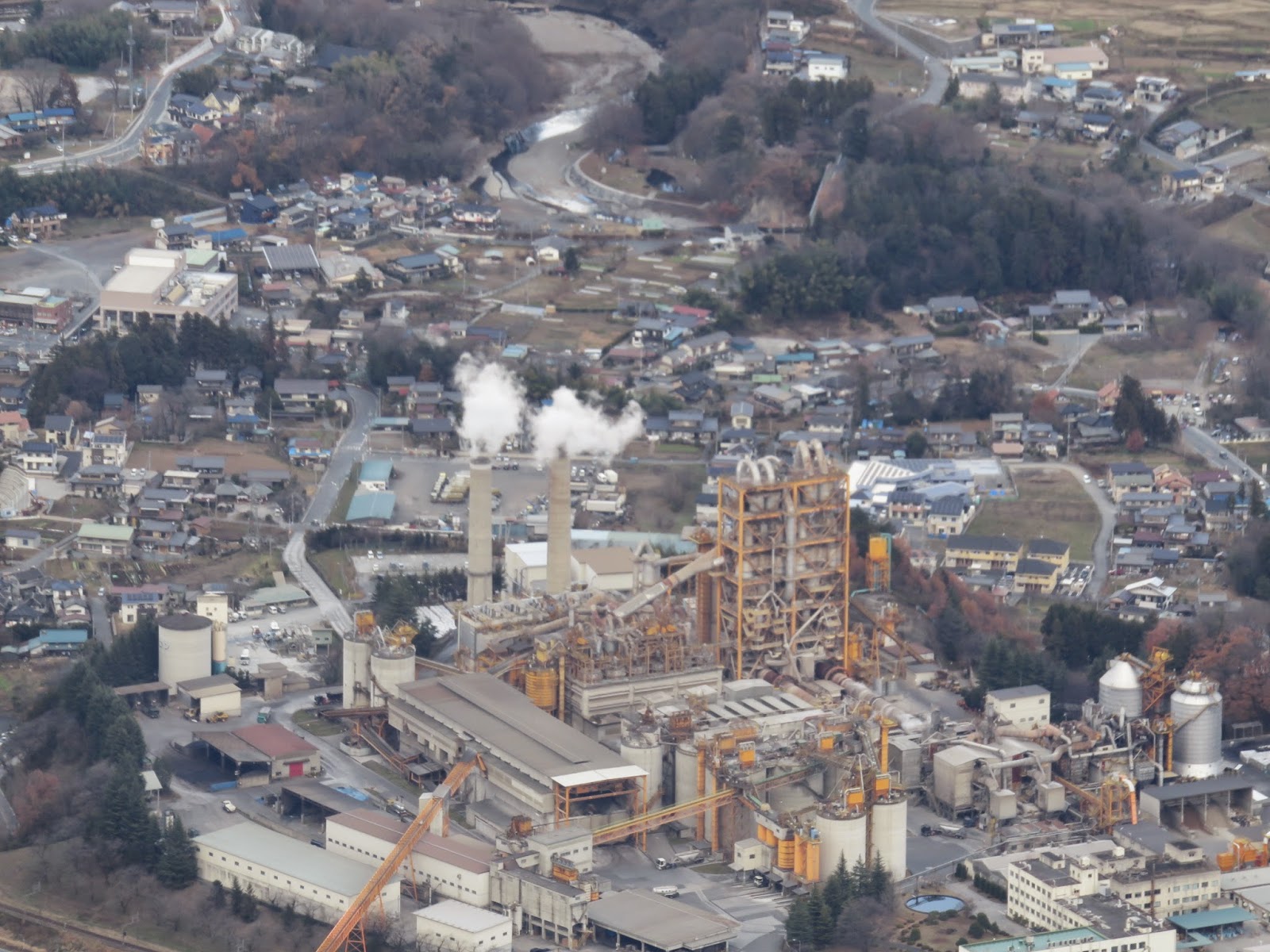
From these terraces come limestone which dates back 200 million years, and which over the last 100 has been quarried at an escalating rate on account of its service as a key ingredient in cement. More specifically, it is this cement that has fed the eruptive growth of the thousands of roads, apartments and skyscrapers of Tokyo, first during the Taisho period (1912-26) but most dramatically following the post-World War II economic explosion.

Limestone from the quarries is transported to the many concrete plants that have sprung up below, evidently centrepieces in the local economy, and there it is processed to feed the Tokyo construction industry.

Perhaps surprisingly, this has not reduced the mountain to some devastated, mined-out wasteland. On the contrary, the southern flanks offer an refreshing hiking experience where aside from the odd industrial siren, the quarries rarely intrude on your day. Admittedly demand for wood has done to the south what demand for concrete has done to the north: much of Bukō-san's forest is young sugi plantation rather than true wild woods. That said, these forests tingle with the whispers of sacred sites and secrets from a mysterious, more spiritual era gone by; at the large shrine on the summit, for example, the evidence of devout observances goes back centuries. And at the peak, if you plan well enough to make it there on a clear day, there unfolds a glorious mountainscape that surely ranks among the finest views in the region.


This walk is just over 9km long, takes about 4-5 hours, and is a navigationally straightforward up-and-then-down concern. There is no major technical challenge, but it can get rather steep in places and presents a good workout for anyone of reasonable fitness.

To get there, take the Seibu Ikebukuro Line to Hannō (飯能), where you can change on the same platform to the Seibu-Chichibu Line as far as Seibu-Chichibu (西武秩父) station. From here, take a taxi for about 20 mins. (approx. 2500 yen) to Ichi-no-torii (一の鳥居), on the east side of the mountain. (You can also get off the train one stop earlier at Yokoze (横瀬) station and walk, but this takes an extra two hours along a road in frequent use, not least by trucks trundling in and out of the concrete plants on the way.) You'll finish on the west side at Urayamaguchi (浦山口) station on the Chichibu Main Line; note that this line does not accept PASMO or SUICA cards.

As an aside, like most walks in this part of Saitama, you will pass Musashi-Yokote station on the way. By means of a platform sign it proudly declares itself “the station with goats", so be sure to look out of the window for reference.

“House of Goats”.

Friday, 5 December 2014

The Obscenity of Obscenity - or, Get Off My Ship

The Tokyo police, for the second time this year, have arrested a Japanese citizen, Megumi Igarashi, for expressing her plans to build a kayak modelled on her own vagina – or, as the official parlance refers to it, 'three-dimensional obscene data'.

 
Read that again, if you please. Three-dimensional obscene data.

No, I don't have a clue what that means either.

Let's try to unpack this a bit. Recall, if you will, that “obscenity” comes from the Latin obscenitas, meaning “impurity”, “immorality”, or “filthiness”.

Filth. A powerful concept. A dangerous concept.

Its evokes dirtiness; pollution; immorality. It carries a strong emotive charge of hatred and disgust, a roar to punish and forbid. It is that most sinister of things: a taboo. It does not describe its object, but rather projects on it a repulsive odour, such that we assume that it is to be taken for granted as foul without even bothering to think about it, and that anyone who thinks otherwise shares in its foulness.

Make no mistake. “Filth” is rarely an inherent quality of the object being described. It is more often a stain produced by the describer and splashed upon something he or she wishes to damage.

This makes it a concept less fitting, perhaps, to the realms of informed and sober reasoning, such as legislation – which is why it is all the more disturbing that any society should have ever seen fit to give it a place in its lawbooks. It is a subjective, not objective, judgement, measured not by harmful outcomes but by the tastes, instincts, prejudices and political interests of the person or society judging. It has nothing to do with the public good, and everything to do with that great shipwreck we humans call morality, which has proven a far less seaworthy vessel than that of Igarashi-san's design.

Take a few moments to think about what you consider immoral. Did you come to the conclusion that those things are immoral by yourself, in a way that satisfies your own critical reasoning, your emotions, your curiosity, and your concern for others? Or are you afraid of something that might happen if you think differently?

Any morality grounded in force and fear is no morality at all. It is slavery.

Humanity must correct its mistakes regarding obscenity. It must drop the arrogance by which for hundreds of years it has upheld systems of torture, murder and abusive power relations which it then has the gall to call morality. These concepts are only valuable if they relates to tangible, demonstrable outcomes of harm to human beings or the world around us.

To be clear. Vaginas are not obscene. Penises are not obscene. Sexuality is not obscene. Our bodies, and all parts thereof, are not obscene. There is nothing immoral, unclean or offensive about any of these things.

Igarashi-san makes exactly this case on her website, and further contends that while vaginas are uncompromisingly subject to taboo in Japan, penises, by contrast, are not. I have personally encountered evidence for the latter and documented it here. “Obscenity” thereby takes on an aspect of gendered discrimination, which magnifies the gravity of the problem many times over. This is mirrored, incidentally, by the unpardonable Euro-American terror at the female breast, whose consequences have included breastfeeding mothers being harassed, abused, or expelled from public premises.

So what is obscene?

For a start, the idea that parts of our bodies are obscene, is obscene. Obscenity laws are obscene. Censorship is obscene. Coercion is obscene. Political control over art is obscene. Sex-negativity – the notion that sex and sexuality carry a negative moral charge – is obscene. Moral panic is obscene. Gendered and heteronormative prejudice is obscene. The use of taboos to socially control people's bodies, especially women's bodies, is obscene. And cultural, ideological, political or religious forces which advocate sex-negativity and the persecution of those who challenge it, are obscene to the highest pinnacles of wickedness.

Why?

Because all these things here identified as obscene, have an unambiguous historical record of generating, promoting, or coming associated with all forms of tyranny, conflict, social division and the most terrible atrocities in all societies in the world, past and present. They are things that bad or mad societies do. They are inherently villainous practices, because they hurt people. And we can all recognise them as such because we can all study and observe their roles in our collective heritage of crimes against humanity.

Now what does it say about us, when we are happy to entertain these terrors whose cruelties have bled and subjected people in a thousand civilisations, but tremble at the sight of a kayak?

This has not killed anybody. This has not hurt anybody. Therefore, it is not obscene and not immoral. This is not complicated.

Japan's arrest and re-arrest of Megumi Igarashi is shameful in the extreme. The ignominy is worsened in this case because this country, notwithstanding its share of problems with gender and prejudice, has done relatively well to protect itself from sex-negativity and moral panic. Its obscenity laws, which should never have existed, are an anachronistic artifact of foreign influence whose outcomes today are the very meaning of arbitrary. In an erotic art scene featuring all forms of tentacles or fantastic unimaginable paraphernalia, what is even the point of censoring mere genitals?

Perhaps the answer is straightforward. We do not have tentacles – as far as I know, and perhaps excepting some individuals in the UK Treasury – but we do have vaginas and penises. By coercively controlling our discussion and expression regarding these, society attempts to exert power over our bodies; to set the terms and the narratives of our sexual journeys. In other words, all sexual censorship is by definition political censorship.

Or, maybe that overestimates their intelligence. Maybe they are seriously just that terrified of sexuality, and so they spout and swing legislation around in the way that we instinctively scream or flail our arms wildly when in panic. In truth it is probably a combination of both, but either motivation is beneath us as a species.

So long as obscenity, as a concept, remains hijacked by social and political forces disgusted by sexuality and intent on controlling our bodies, it is a meaningless idea, a nothing wielded as a tool of wanton repression. Until we take it back, all laws based on obscenity are illegitimate, and all moral judgements that invoke obscenity are immoral. Our obligation is not to respect them, but to tear them down, and by all means necessary ensure their perfidious architects never construct such nightmares again.

Our bodies are ours, not theirs. Our bodies are our vessels for our journeys through a beautiful universe, and there is nothing obscene about them or any aspect of them. Hurl the hijackers overboard and bail out the bile of their broken moralising judgements. Tell them that we will have our bodies back. Tell them, to their faces: Get. Off. My. Ship.

Friday, 31 October 2014

Mitō-san (三頭山): Three-Headed Mountain

Mount Fuji from the summit of Mitō-san.

Mitō-san (三頭, 1525m), the highest of the 'Three Mountains of Oku-Tama' in western Tokyo, is trickier to reach than the others. For one thing it is scarcely in Oku-Tama at all; it stands in the far southwest corner, on the boundary with Hinohara village and Yamanashi Prefecture. On the other hand, if you go there on a day with nice weather, you can get to see things like this.

 
Mitō-san – so named because of its clump of three summits – was apparently closed off to people in the Edo Period. This left it in peace to grow a splendid forest of huge beeches (buna, ブナ) and maples (kaede, カエデ), which still stand despite the dominance of sugi plantations in the area and display impressive colours in the autumn. This rich mixed forest also supports a thriving diversity of plant and bird life.


In a reversal of its former status, Mitō-san is now the centrepiece of the Hinohara Citizens' Forest (tomin no mori, 都民の森). The mountain and its surroundings are now open to everyone, with a well-equipped and well-maintained network of hiking trails and facilities which attract large numbers of people, although its relative remoteness stops it from getting overcrowded or detracting too much from immersion in nature.

There are multiple hiking routes to choose from, and they are generally quite easy – occasionally steep, but never punishingly so. This is definitely a mountain suitable for beginners, with a lot of cabins and information boards making it easy to navigate, rest or find support if needed. For more advanced walkers, longer routes out of the Citizens' Forest are also an option – you can go down to Oku-Tama Lake, or even up to Gozenyama if you are feeling ambitious enough.

The Citizens' Forest occupies the northwest corner of Hinohara Village, Tokyo. Mitō-san is in the top-left corner. To the north is Oku-Tama, to the west Yamanashi.

The biggest challenge lies in getting there. Hinohara, the last part of Tokyo still designated as a village (mura, ), is a sleepy place, whose mountain and forest coverage far exceeds its rail coverage. Unless you have a car, take the Itsukaichi Line (which branches off the Ōme Line) from Tachikawa to Musashi-Itsukaichi Station (武蔵五日市駅). From there, ride the Nishi Tokyo Bus (2014-5 timetable here) to tomin no mori (都民の森), although it may only run to Kazuma (数馬) where another bus will be waiting to take you the rest of the way. That's about 1 hour 10 minutes and 910 yen one-way, incidentally.

Click below for the full article.

Tuesday, 8 July 2014

The Blazing Gentleman of Shinjuku - or What Next for Japanese Pacifism?

日本国民は、正義と秩序を基調とする国際平和を誠実に希求し、国権の発動たる戦争と、武力による威嚇又は武力の行使は、国際紛争を解決する手段としては、永久にこれを放棄する
前項の目的を達するため、陸海空軍その他の戦力は、これを保持しない。国の交戦権は、これを認めない。

'Aspiring sincerely to an international peace based on justice and order, the Japanese people forever renounce war as a sovereign right of the nation and the threat or use of force as means of settling international disputes.
To accomplish the aim of the preceding paragraph, land, sea, and air forces, as well as other war potential, will never be maintained. The right of belligerency of the state will not be recognized”
-Article 9 of the Constitution of Japan (1947)


On the afternoon of Sunday the 29th of June, a certain Japanese citizen, whose name remains unknown, mounted the girders above the South Exit of Tokyo's Shinjuku Station. Hundreds of pedestrians watched on as this respectable-looking gentleman sat cross-legged on a mat, produced a megaphone, and protested against revisions under discussion to Japan's constitutional pacifism which had privileged it with seventy years of peace. Then, as firefighters approached, he doused himself in gasoline and burst into flames.

Japanese pacifism, and Article 9 of the Constitution which protects it, is a complex matter. It goes right to the heart of questions of Japan's identity and national journey, questions whose answers are honestly not at all straightforward. Let explore these today.


First, however, we should pause to give the blazing gentleman his due, for it takes tremendous courage, whatever one's opinions, to consign oneself to the flames. Appearing in his fifties or sixties, he was likely aware that he was joining a blistering worldwide heritage of self-immolation as political protest: protest tragic, protest divisive, but protest undeniably shocking and potent. Protest that declares that no matter how painful the flames may be, the pain of what is protested against is one thousand times worse.

Thích Quảng Đức did it in Saigon, the horror of that moment preserved and immortalised in Malcom Browne's timeless photograph from that war the Japanese authorities so controversially supported. In closer memory Mohamed Bouazizi did it in Tunisia, and the flames set alight the entire Middle East and North Africa – and still they burn. From Tibet to Tamil Nadu, and goodness knows where else, these flames still rise.

Before closing my eyes to go to Buddha, I have the honour to present my words to President Diem, asking him to be kind and tolerant towards his people and enforce a policy of religious equality.” - Thích Quảng Đức, 1963. A witness observed that “he was completely still, while those of us around him were crying and prostrating ourselves on the sidewalk.

Speak not a word against people who do this, or the flames will burn on and consume us all. We are not innocent bystanders, and we may hold no grievance against them for making us watch them burn. Instead, listen. Their actions accuse us: we have created a world which inflicts worse than this on people. We have created a world so insufferable to some of its members, that the only way left that they know to fight it is to set themselves on fire. But how dare we be shocked by a person on fire, if not by our societies' crimes against humanity?

In the case of the blazing gentleman of Shinjuku, his challenge to us is this: the fire is less painful than what will happen to a Japan which abandons its pacifist identity.

And he may have a point.

Almost two weeks after his protest, the Japanese media has still failed to provide any substantial coverage of his actions, and his name and current condition remain a mystery. As with the Fukushima nuclear disaster, the affair reeks of a cover-up, and in particular state broadcaster NHK is under fire for all the signs of partisan censorship.

That's a poor start. We don't have to agree with his words – after all, they concern the future, so any certainty in any direction is premature. But if we dare to call ourselves human beings, we do have to care, we do have to listen, and we do have to seek to understand. So unlike NHK, let's take a closer look at his concerns. Let's consider the story of Japanese pacifism.

Saturday, 31 May 2014

Rhododendrons on High: Hinokiboramaru (檜洞丸), Tanzawa Mountains

 
Some mountains draw attention for the marvellous views they give across their surroundings. Others, however, concentrate all that beautiful intensity into themselves, and discharge it in through your boots with every step you take. The mountain featured today falls into the latter category, and is especially popular in the last days of May, or early June, when the way to its summit erupts in white azaleas.

 
Make no mistake though. Hinokiboramaru (檜洞丸) is no overcrowded, tourist-encumbered Ōyama or Takao-san. Proximity to these flowers is something each of the people in these photos has earned by offering up buckets of sweat and lactic acid. This 1600m peak, whose name denotes a “circle of cypress caves”, lurks deep in the Tanzawa mountains, and an excursion up and over it is less a hike than a swashbuckling, sinew-grinding adventure.

The beauty of the Tanzawa mountains is in their diversity, and here that colourful variegation is on show in all its glory. To demonstrate your worthiness to see it, Hinokiboramaru lays down challenges no less mercurial: the paths and environment transform before your eyes, zone after zone, each time settling into a new configuration for you to negotiate. Expect plenty of this:


And this:


And certainly no shortage of this:


As well as a fair bit of this:


And if you are lucky, perhaps even this:


So while it does not demand specialist equipment or more preparation than other day hikes, Hinokiboramaru is not for the faint of heart. The way up the mountain is somewhat strenuous and often narrow of path, while the ridge that follows presents challenges of an above-average technical difficulty, featuring a rumbling series of ladders, hand-assisted or chain-assisted rock climbs and boardwalks. Injury opportunities are plentiful if you aren't careful, and if you get stuck, the only way out of this remote mountainscape involves misery, expense and a helicopter.

But don't let that put you off. These mountains reward you commensurately for every ounce of courage you put in, and so long as you approach them with respect, a cool head, and even only moderate fitness, you will be able to get from beginning to end of this route and feel better for it. The area is well looked after by the Tanzawa national park authorities, with excellent signposting and trail maintenance. Even dogs and small children do this walk, as encountered on this occasion, on a day when the average age of people on this hike seemed nonetheless well over fifty.

Do, however, plan well. Good hiking shoes are absolutely essential, as is enough food and water to last you the full way. Pay attention to the weather forecast and do not go on a day with a significant chance of rain, which would make this walk's many high and narrow trails too precarious. And avoid trying it in winter unless you have special equipment for the ice and snow, along with past experience with such conditions.

It takes about an hour and a half to get from central Tokyo to Shin-Matsuda (新松田) station on the Odakyu Line, followed by another hour on the Fujikyū Bus (1180 yen either way, regular and runs throughout the day, click here for timetable) to reach the West Tanzawa Nature Classroom (Nishi Tanzawa Shizen Kyōshitsu, 西丹沢自然教室), where the walk begins and ends. As the walk can take a good six to seven hours, an early start is strongly advised.