Showing posts with label International Relations. Show all posts

Friday, 25 October 2013

The Struggle to Establish Sexual Diversity on the United Nations Agenda (Master's Thesis)


The primary result of my two years' research at the United Nations University in Tokyo, which I am making public here as promised. It is too long to post here in full, so if the abstract and contents attract your interest, you can view the complete text by clicking here.

I am not an academic, and write things like this with the sole purpose of making a contribution to a better world. So though I am aware my written English is a bit of a minefield at times, I deliberately do my best to reject academic jargon and politically-motivated euphemisms throughout this kind of work; write without any consideration for the effect on my own prospects; and will make no pretence at impartiality, for sometimes there is no such thing. So if you are not of an academic background but still take interest in the subject matter, then please do not feel daunted by the scale of this work, and feel free to ask me if you want anything explained more clearly.


Abstract
The great diversity of human sexual and gender identities, senses, behaviours and feelings is a central part of the human experience. Hostility to this diversity, along with the prejudicial violence, discrimination and ostracization that hostility produces worldwide, constitutes today one of the gravest challenges to the United Nations's founding pursuit of the rights and dignity of the human person. Nonetheless, this issue has been marginalized and misunderstood in international politics until recent decades, becoming recognized and addressed only during the 1990s and 2000s, primarily on the human rights agenda: and then only through a painstaking struggle that still endures against hostile forces who seek its exclusion. This study thus inquires into the current state of sexual diversity as a human rights concern in international policy discourse and practice, particularly in the United Nations agenda. It examines the recent history of sexual diversity as a complex political and human rights issue; the movement whose efforts have advanced it; and the hostile counter-movement's drivers, methods and contexts. Ultimately, in pursuit of an international system free of heteronormative biases and the recognition of the full relevance of sexual diversity across all its major policy fields, the thesis explores and asserts the significance of sexual diversity for the vision and practice of the United Nations – and above all for the integrity and prospects of universal human rights.

CONTENTS
Introduction
Chapter 1 – The UN Agenda: Overcoming Exclusion
a) Human Rights
b) Development
c) Peace and Security
d) Convergence
i) Gender
ii) Sustainability
iii) Health
iv) Towards Sexual Diversity Rights

Chapter 2 – Sexual Diversity: The History and Movement
a) Sexual Diversity as Politics
b) Sexual Diversity as a Human Right
c) The Sexual Diversity Rights Movement: Academics
d) The Sexual Diversity Rights Movement: NGOs and Social Activists
e) A Case Study: Gaya Nusantara, and the Sexual Diversity Rights Movement in Indonesia

Chapter 3 – Hostility to Sexual Diversity: The Counter-Movement
a) Counter-Discourse and Counter-Practice
b) Analysing Hostility
i) Cultural Relativism
ii) Construction of History
iii) Moral and Medical Pathologization

Chapter 4 – Sexual Diversity Rights: The Challenge
a) Conclusion: Universal and Diverse – Not One or the Other, but Both
b) Recommendations
i) The UN
ii) Activists
iii) Moral Authorities
iv) Academics
c) An Exhortation


Again, you can access the full text here. In addition, the International Lesbian, Gay, Bisexual, Trans and Intersex Association (ILGA), one of the foremost international sexual diversity rights organizations bringing together over 750 groups around the world, has also made the text available on their website here (angry photo included!).

Sunday, 16 September 2012

Reflections on International Peace and Security


For everyone following the Hokkaido-Tohoku series, don't worry – it's still on course, and this is just a timely interlude. Specifically, my contribution to the UNU International Peace and Security course of 2012, in the form of extended reflections I did on its themes in the previous year. Please excuse the small font-size errors which I've yet to work out how to fix.

I am posting this mainly for any benefit it might give to those currently working their way through this course, either on clarifying some of the topics or offering (perhaps) some perspectives on them. Even better if it's of interest to other people too, as a taste of what's going on in this organization that – hypothetically, at least! - is meant to help stop us from all destroying each other.

HOWEVER!!!

I'm putting this out in the hope that it helps and encourages people to think, and think critically, thus to develop their own opinions and therefore characters. I am not putting this out for it to serve as a substitute to that thinking. Plagiarism is bad! If anyone wants to use ideas from here in their own reflections or other work, please make proper reference to this blog entry! Because if you take something I came up with and use it as your own, I will be most assuredly upset. And when I'm upset, I write scary, scary things that drive whoever sees them to insanity just by reading them and cast the world in flames. And I guess that would defeat the point of discussing peace and security – so let's be friends and all do what is right for peace and security, okay?

And yes, each "wall" is one week's reflections. Writing is fun.


INTERNATIONAL PEACE AND SECURITY
Weekly Reflections: 12 September – 13 October 2011
Ai Chaobang (a.k.a. John Ashton)


WEEK ONE: Responsibility to Protect, Terrorism, and Proliferation of WMDs
WEEK TWO: International Law
WEEK THREE: Peacekeeping, the UN System and its Foundations
WEEK FOUR: Humanitarian Intervention, National Interests and Democracy

Thursday, 12 January 2012

Hiroshima - The Price of Peace

"安らかに眠って下さい 過ちは 繰返しませぬから"


See that? The event which did it heralded a new era in humanity's history: an era we must admit as one of the worst mistakes of our kind.


This is the Hiroshima Peace Memorial Museum. It is located in the Hiroshima Peace Memorial Park, which occupies the city's central "island" from the T-shaped Aioi Bridge in the north to the Museum in the south. It is a peaceful green space, dotted with monuments like the Children's Peace Monument, the Hiroshima Peace Memorial Hall, the Peace Flame, the Peace Bells, and the Gates of Peace.

You might discern a certain theme here. This should not be a surprise.

On 6 August 1945, an American B-29 aircraft dropped a "special bomb" which exploded above what was then the Hiroshima Prefectural Industrial Promotion Hall – now the iconic ruin above. The temperature on the ground reached four thousand degrees Celsius. Up to 80,000 people going about their lives were incinerated, skeletonized, their flesh melted, their organs ruptured, their bodies ripped apart by the shockwave. The annihilation was absolute: the city centre and surrounding districts were flattened to dust. Hospitals and schools were obliterated; so too Hiroshima's ancient castle; the Hondōri shopping arcade; the Shukkeien Garden. Whatever still stood, erupted in flames; rising radioactive ash collected in mositure and fell back to Earth as "black rain", which survivors, desperate with thirst, held open their mouths to catch. Over time, radiation from the blast would kill another 70,000 people and leave many more as hibakusha ("explosion-affected people") struggling with radiation sicknesses, social discrimination, survivor's guilt, and memories not renderable in words.


Hell was opened upon Hiroshima that day. The Peace Museum bears witness to this massacre through survivors' testimonies, historical records, and pieces of buildings or everyday items like watches and bicycles hit by the blast, along with detailed consideration of the exact implications of what it meant in practice to be a human being in Hiroshima a few seconds after 8:15am on 6 August 1945. One survivor remarked that the sight of what followed was indeed reminiscent of hell; except that in pictures of hell, you at least get patches of green or blue here and there. Hiroshima lacked even that: nothing but red, black and brown. And of course, Nagasaki would suffer a similar experience three days later.


City of Peace
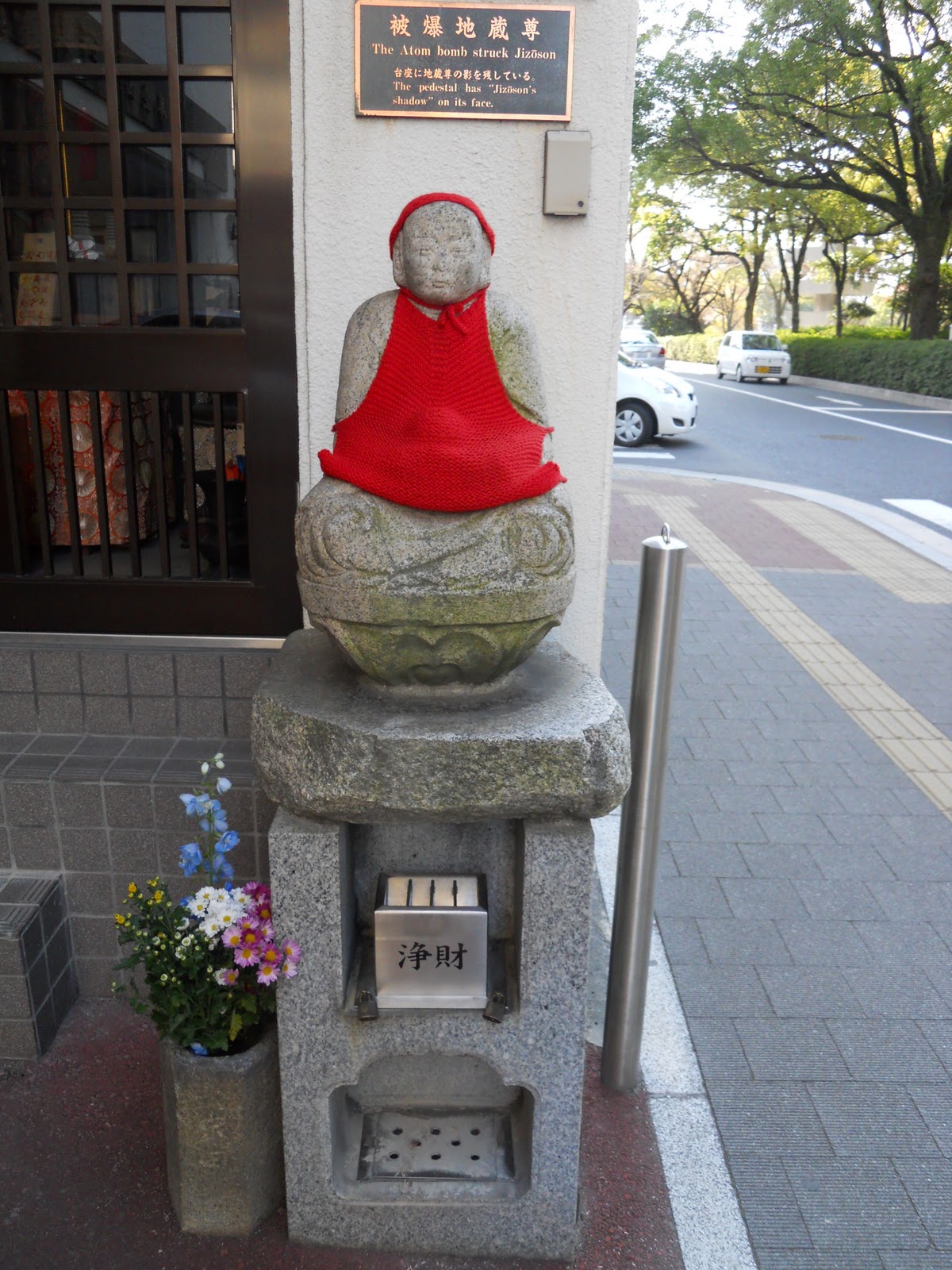
There are forms of injury which no-one can expect you to just accept and move on from. That said, the city we found on the site of that devastation left me profoundly impressed. In rebuilding, what was once the city centre was given over entirely to the Peace Park, and as its memorials attest, Hiroshima has resurrected itself upon a new identity dedicated to remembering and learning from the horrors of history. The city is especially active in the international struggle to abolish nuclear weapons; meanwhile the unidentified ashes of 70,000 of the weapons' victims are kept within the park's memorial mound, while the cenotaph, below, contains a register of the names of all those the atom bomb killed.


The city reflects peace in a more immediate sense, too. It is quiet, not a fraction as crowded as Tokyo. Trees line the gentle rivers which feed the harbour, and people chug around on trams in view of solemn mountains on the horizon. Yet there is a liveliness too, a genuine vibrancy, which hums in the air of the new central district and Hondōri, not to mention in the intensity of the okonomiyaki restaurants. The city has character, and to think of where it has come from to build it – from the very image of the End of the World it once was – must stir respect and amazement.


More recently, Hiroshima's traumas have taken on a new layer of meaning following the March 2011 tsunami and Fukushima nuclear disaster. In the city's Peace Declaration of August 6 last year, the mayor stated: 'The trust the Japanese people once had in nuclear power has been shattered. From the common admonition that "nuclear energy and humankind cannot coexist", some seek to abandon nuclear power altogether...The Japanese goverment should humbly accept this reality, quickly review our energy policies, and institute concrete countermeasures to regain the understanding and trust of the people."


It Was Wrong
I am not surprised that some people still argue the bombing was justified. I am surprised by the apparent mainstreamness of that argument in the countries which carried it out. It was "necessary". It "saved lives". It was "war", and was therefore okay.

The context is indeed important, so let's remember it. The conduct of the Japanese empire during and prior to the Pacific War included some of the most repugnant, systematized atrocities ever wrought by the human race. Great propotions thereof were visited upon the people of China – and I write as a half-Chinese myself, whose blood has repeatedly boiled down the years as I learnt of the two centuries of monstrousness perpetrated upon the Chinese people by predatory foreign barbarians from West and East alike. The Japanese manner of fighting was honourless and utterly cruel: mass rape, torture and bloodthirsty experiments on civilians, abuses against prisoners, pillaging of colonies, all on an unbelievable scale.

The Japanese perspective is often ignored in Western education about this period, and should be better studied – though it does not diminish Japan's culpability. Japan was effectively forced by European and American imperialism to either die or become a competitive empire just like theirs. Yes, it was economically vulnerable, the target of ferocious racism, and surrounded by countries whose entrails were getting feasted on by those same Westerners. The arrogant, exploitative, xenophobic paradigm in Western civilization needed someone to stand up to it, and Japan could have done that. But Japan chose differently: instead of standing up to the West, it remade itself in exactly the West's image. Nothing aside from Japanese choices determined that it would brutalize the Chinese, oppress the Koreans, or cast contempt instead of kindness upon the Southeast Asian peoples it genuinely liberated from the imperialists, only to replace their tyranny with its own. None of this wickedness was necessary; all of it was chosen. For these choices, the Japanese nation must bear responsibility – and that it still has trouble doing so even today is well-known, the stuff of less-than-faithful history textbooks and international scandals over the honouring of war criminals.

But the atomic bombing of Hiroshima was still one hundred percent abominable.


Because if we're going to remember the context, let's remember it properly. None of the above was or is unique to the Japanese. The 1937-1945 cataclysm was not a matter of "good" countries versus "bad" countries. In fact, every major party to World War II had a share in all of this manner of shameful conduct – including the winners. The German and Japanese crimes against humanity, reprehensible and sick as they were to the extreme, were ethically equivalent to the crimes of the United States in the saturation firebombing of Japanese civilians: the calculated decision, as a military tactic, to unleash an orgy of flaming terror upon cities like Tokyo, Osaka, Nagoya, Kobe, Sendai and Aomori, most of which were made of wood, each of which was levelled, in some cases completely, burning more people to death than the atom bombs with no lesser callousness. The British conducted themselves little better towards German cities. And as we consider Japanese atrocities against civilians in its colonial and occupied territories, so too must we consider those of the Europeans in Africa, the Americas and Asia – some of the latter's peoples had the misfortune to experience both! – as well as the US against its own colonies and indigenous populations.

Like the Japanese, the Europeans and Americans still have trouble with the notion that they did anything wrong. Attacking or tormenting those not able to defend themselves constitutes an atrocity and a crime against humanity in all circumstances, no different to more recent examples like the attacks on the World Trade Center (2001) and London Underground (2005). And yet, oftentimes the smug denialism and responsibility-dodging becomes downright nauseating.

We must confront ourselves with the question: when we condemn an atrocity, do we abhor it because it is an atrocity against humankind? Or do we only bother to call it an atrocity if "they" do it to "us", rather than "us" to "them"?

Any meaningful dividing line in the 1937-45 cataclysm had nothing to do with nation. All nationalities produced their heroes, their villains, and most of all their majorities who languished somewhere in between. The entire period was a global outbreak of insanity and bloodlust, by which the most contemptible fiends in all countries, with all their nationalist egos and xenophobic convictions, laid waste to the most innocent and vulnerable human beings in all countries. That the carnage of Earth went as far as it did represents an existential breakdown of sanity within and between all peoples, for which all humanity, as a single race, must take responsibility.

What the United States should have done instead of using the atom bomb is a pointless question: because by the time the bombs were used, its firebombing of Japanese cities had already sealed its place in the record as as dishonourable a faction as any in that war, and by then all possible outcomes were set to bring forth a miserable post-war order on Earth. Such was exactly what we got, afflicted thereafter the tyrannies, bloodbaths and crimes against humanity of the Cold War – which incredibly, some still argue was an era where nuclear deterrence maintained peace.

All nations have butchery on their records, and in order that the lessons are learned, those mistakes must be the first thing all nations teach their children in history classes: starting with the recognition that an atrocity is an atrocity – period. Even if the other side is doing it. Even if your cause is "right" and theirs is "wrong". Even if the only alternative is that you die fighting, though in practice the choice is never so crude a binary. It is still evil; still inhuman; still a choice you make and for which you are held to account by the universe forever.

Otherwise, we will never be free of the scourge of crimes against humanity. The manner of arguments put forth to justify what was done to Hiroshima can and have been used in defence of every act of mass carnage ever committed. Open the door of excuses even an inch and every demon from the pit will pile forth through the gap; it must remain locked, bolted and welded shut for eternity. And to this day and age, with the same "good guys" from World War II still involved in wars of aggression, attacks on civilians and the torture of prisoners of war, it is clear that there are still those among us who see fit to hold the door wide open, in delight at what satisfying allies the demons make.


Correcting our Mistakes
Within this brazier burns a flame which will only be extinguished when all nuclear weapons on the planet have been destroyed.

In theory, this is an inherent goal for all that lives, as necessary as to drink or to sleep. In practice, nuclear disarmament has been preposterously difficult because of the derangement, on the part of several nations, that they might need, or even have the right to, the ability to sear the flesh of human beings as was done to a quarter of a million people in Hiroshima and Nagasaki.

They do not have this right. No-one possibly can – not even those nations such as India, Pakistan, Israel and North Korea, where people may feel, accurately or not, that a nuclear arsenal is all that preserves them from destruction by their enemies. Once more, not even death is an excuse: any nation, any human being, should prefer his or her own demise than to enter the annals of history as having deployed so odious a weapon, sullying his or her name and that of the human race forever. As for countries with not even this pretext, indeed none at all, who still cling to their own nuclear weapons for the sake of showing off large national genitals – the United Kingdom first among them – shame, disgrace and degredation. Any person who could countenance a nuclear attack on a human population, in any situation, towards any purpose, is complicit in the drowning of our species in the mire of barbarity.

Deterrrence is as unworkable as it is heinous. Unworkable, because Fear is the weakest of all motivators (ask yourself honestly: if you truly believe in a goal, especially if driven to it by anger, are threats and taunts from your enemies going to convince you to abandon it, or propel you towards it with double determination?) Heinous, because a world ruled by Fear is not a world any of us should desire to live in; because we can do better; because we deserve better.

Nuclear disarmament will not solve the problem of conflict. These weapons were never the source; only the hideous consummation. Other weapons – conventional bombings and explosives, small arms, and our very own limbs and appendages – have created a far greater magnitude of suffering throughout the entire nuclear age. But the power of the mushroom cloud is its embodiment of something worse still: of an order in which humanity accepts such barbarity as natural; as "realistic"; becomes indifferent to the suffering it begets; and establishes it as the balancer in a status quo it ridicules as madness in the very acronym of Mutually Assured Destruction, even as it embraces it with the delirious trappings of peace.

Will the day arrive when Hiroshima's flame can sleep? Can humanity be rid of its nuclear weapons? That goal is not idealism, but the only reality worth living for. A humanity capable of this is the only humanity that deserves to exist.


Tuesday, 20 September 2011

In Defence of Video Games - Artistic Merit and Socio-Political Relevance


Video games remain frowned upon in mainstream society. Like any emerging art in its day, they struggle to break into popular recognition as art at all. That we widely consider they are only "for kids" only chinks at the surface. Admit you like them, and your employer may sack you. Suggest they make serious aesthetic contributions, and people may laugh at you. They are even scapegoated for serious violence and terror, from school shootings in the US to last month's English riots.

I oppose this paradigm. As art is subjective by definiton, I do not expect to suddenly convince many skeptics, but here are ten examples from my own journey of why in my opinion, video games may exhibit as much artistic merit, or even social-scientific relevance, as the utmost in literature, cinema, music or visual arts; indeed, few art forms offer the same opportunities to combine all these into an overarching and interactive experience far greater than the sum of its parts.

All these examples come from my own journey, with the specific scenarios among those I found most potent in their respective work, while representative of its overall power.
To those whom it may concern, be aware of potential spoilers in this post!

(And excuse the formatting errors. I'm not exactly good at this.)

1) Bioshock (PC)"Would You Kindly"
'I am Andrew Ryan, and I am here to ask you a question. Is a man not entitled to the sweat of his brow? "No," says the man in Washington, "it belongs to the poor." "No," says the man in the Vatican, "it belongs to God." "No," says the man in Moscow, "it belongs to everyone."
'I rejected those answers. Instead, I chose something different. I chose the impossible. I chose...Rapture.
'A city where the artist would not fear the censor, where the scientist would not be bound by petty morality, where the great would not be constrained by the small. And with the sweat of your brow, Rapture can become your city, as well.'

Anyone with even a cursory knowledge of the most potent videogame moments knows this one well; may feel shaken at its very mention.

The bulk of this game has you struggling through the underwater city of Rapture, a self-interest, free-market paradise-gone-horribly-wrong much inspired by the Objectivism of Ayn Rand. As such the story directs you to find and subdue its maddened founder, the (brutally) idealistic and unmovable Andrew Ryan. Eventually you encounter him in his office – at which point the game goes into a cutscene in which, in a shocking exposition of the player character's story, it turns out your character was mentally conditioned all along, compelled to obey any order associated with the trigger phrase "would you kindly"; at which point he uses it to order you to kill him, still stuck in the cutscene with no control over your actions as you watch yourself beat him to death with his golf club regardless of what you want to do – all as he defiantly pronounces his defining principle: "a man chooses, a slave obeys".

The effect cannot be replicated in mere words, and was painstakingly designed. Andrew Ryan chose to go down on his terms, not yours, and his final, ultimate insult to the player is a massive mind-screw. In this one-minute sequence seethes so many levels of challenges to your values, your society's values, your identity as a person who plays video games, and your condition as a human being, that it would be impossible to properly cover them here; a thousand essays could be written to analyse it, and probably have. Videogames are unique in art for typically giving you choice, control, agency within the work; but into your guts this sequence propels the alarming question: are you really in control? Or are you a slave, sleepwalking through life or the game alike, doing what you are told, what is expecting of you, following your railroad with no way to leave that path?

And if so, why? Why did and do you obey without question, accept what authority or structure would have of you without stopping to think about why you do it, and whether it is right? And so control is taken from you; if you don't use the choice, there's no point it being available at all. "A man chooses, a slave obeys."

From videogames to every institution in everyday life, this event has resonance; the sort which locks itself among your mental and intellectual reference points and demands you consider its relevance time and again. And from where I stand, its significance is starker still: for so many horrors in this world come from that terrible invention called obedience, and its usurpation of human ethics. In this day and age, as humanity faces crises which for the first time threaten it on a universal scale, it is more important than ever that we question everything we are expected to follow by our twisted social paradigms, with their whisper into our souls we cannot hear but cannot resist: "would you kindly".


2) Pikmin 2 (Nintendo Gamecube) – Cuteness, ecological depth and a Japanese social perspective

"When I look at the president, I can't see myself climbing the corporate ladder. To be a manager, you've got to be an inhuman, heartless villain. This trait allows them to flog their dedicated workers without mercy and still sleep at night. I feel that same merciless cruelty radiating from this metallic altar. I wonder if it was once used for dark, unspeakable ceremonies. Or perhaps it was once the desk of a corporate boss. We'll never know..."

"Sometimes it's difficult to tell if a treasure is natural or manufactured. The ship has concluded that this treasure is natural, but I'm not so sure. The ship sulks and gripes for days if I disagree with it, so I'll keep my opinion to myself."

"This must be the fossilized remains of an enormous land-dwelling creature. I was unable to piece together the entire beast, but it certainly had a massive head! It's obviously quite different from the Pikmin and other creatures I've encountered. Perhaps it's an extinct creature that couldn't adapt to changes in its environment."

A charming contrast to the previous example, this is perhaps my all-time favourite game. Within it are combined so many different elements of excitement and engagement with the mind and the heart: a strong ecological theme in what is first and foremost a real-time strategy game, in which you play a treasure-hunting captain on a mysterious planet suspiciously resembling Earth, directing armies of creatures called 'Pikmin' of different colours and abilities to fight predators, change the terrain and salvage treasure for your hoard. In doing so Captain Olimar hopes to dig the frieght company he works for out of a monstrous debt, but only by relying on the Pikmin can he complete necessary tasks too mammoth to accomplish alone.

The civilization from which your captains come is on a much smaller scale than ours – hence how the scenery resembles ours but far magnified, and the treasures endearingly mundane objects from everyday life like batteries or sardine containers, only enormous (the first quote above concerns a manual fruit juicer, and the second a whistle) – but no indication is ever given as to where we humans are, whether we existed at all, or if we did, where we have gone. As he reflects on the treasures, Olimar and his amusingly full-of-itself ship AI occasionally twig how they hint at some strangely absent civilization; but that is as far as humanity is touched upon. Perhaps this is an Earth long after an unsustainable humanity's extinction, by when it has recovered its natural balance and is carrying on without us?

There is such richness in this game's experience that it must be played to really appreciate it, but I will touch on just one more humourous aspect: the Japanese social commentary that emerges time and again from hard-working, life-for-the-company Olimar's reflections in his log, the ship's sassy attitude, and the bumbling and rotund shacho (company president) who spends the first half of the game bombarding Olimar with daily emails describing his terrified attempts to evade the loan sharks, and the second venturing back to the planet as a playable second captain, in the search for the previous assistant captain who was left behind. It feels like a light-hearted but poignant satire of modern Japanese business and family life, so masterfully reflected in these characterizations and relationships. This game is a delightful aesthetic experience.

Wednesday, 7 September 2011

The Powerful Bear

 He deserves a post all to himself, doesn't he?

There are people in this world who view humanity's existence as but a competitive struggle for power. To dominate others. To maximise one's slice at others' expense. Every man or woman for him or herself. Human nature, they say; or the nature of the state system. Some, in arrogance, title themselves "Realists", as though to imply they are so enlightened as to grasp the "truth" of the world from which most people hide behind idealistic illusions. It's all about accumulating power, they say: power, of course, which comes from the barrel of a gun.

They know nothing of power.

Take this bear, for instance. One look at those big round eyes and you are compelled to touch him or hug him. No resistance is possible.

But the bear rejects the violent, coercive notion of power. The bear doesn't say "Hug me or I'll shoot you!" The bear won't lock you in a cell. The bear won't have you sacked. The bear won't cut your benefits. The bear won't deport you. And if he did, it would hardly convince you to hug him.

No, the bear persuades you to hug him because hugging him feels good. He doesn't force you to do things you don't want to do: he gets you to want to do things.

This bear could get you to do many things that the barrel of a gun could not, because power is not a linear measure of your ability to crush people. It is qualitiative, not just quantitative: there are many different kinds of power, whose effectiveness varies between people and situations. Which is more powerful: the tank on Tiananmen Square in 1989, or the young man who was filmed standing in its path, blocking its advance, broadcasted around the world to become an international symbol of the Chinese Communist Party's brutality which dogs its reputation (and rightly so) to this day? Those tanks were deployed to destroy one city's rightful opposition; that man who stood in its path inspired up one planet's worth.

Force, fear and the infliction of suffering are ineffective at getting people to do what you want. They breed indignity, hatred, give people a reason to fight you. Crushing dissidents is expensive, especially when each abuse against humanity generates a further ripple of loathing – and incentive to your destruction – through families, friends, communities and everyone in the world who watches you do it on YouTube. Those to whom power is to make others fear, doom themselves. This outcome is absolute.

How better for society to uphold a kinder and more respectful power, like that of this bear? More demonstrations of care, more love, more persuasion, more reliance on decent reasoning and positive feelings, more leading by good example, more abiding by the same standards you expect of others, and more consideration of the outcomes for them. That is more effective at getting them to do what you want; they will do it better; and you won't have to watch your back for their inevitable daggers if you'd chosen to make them fear. It also makes society that much more pleasant for everyone in it; would we not prefer to live in a world like that?

I am soon to start my course at the United Nations University. If I like what I see, then however hypothetical this is today, I might just go on to investigate opportunites for UN- or UNU-related work. If ever I do, the bear shall have a prominent position on my desk, such that its power radiates upon all who come before me.